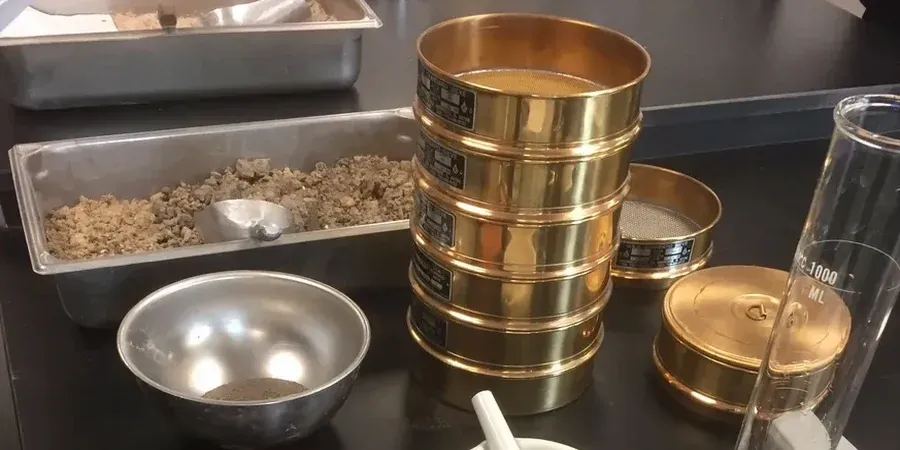
Geotechnical laboratory testing forms the backbone of every safe and economical construction project in Ottawa. The Laboratory category encompasses a suite of standardized tests performed on soil and rock samples recovered from boreholes, test pits, and construction sites across the National Capital Region. From routine index properties like grain size analysis (sieve + hydrometer) to strength and compressibility assessments, these tests provide the quantitative data engineers need to design foundations, retaining walls, embankments, and infrastructure that can withstand both everyday loads and extreme events. Without accurate lab data, designs would rely on assumptions that could lead to costly overconservatism or dangerous underdesign.
Ottawa’s unique geological setting makes comprehensive laboratory testing particularly critical. Much of the city is underlain by thick deposits of Champlain Sea clay, a sensitive marine clay that can lose significant strength when disturbed or subjected to changes in moisture. This Leda clay, deposited over 10,000 years ago, is prone to landslides in some areas and presents challenges for excavation and foundation support. Glacial till, often dense and overconsolidated, overlies bedrock in many parts of the region, while alluvial sands and silts occupy floodplains along the Ottawa and Rideau Rivers. Laboratory characterization of these materials—especially Atterberg limits for fine-grained soils—is essential to distinguish between low-plasticity silts and high-plasticity clays that behave very differently under load.
Laboratory testing in Ontario must comply with provincial and national standards to ensure results are defensible, repeatable, and accepted by regulatory authorities. The primary framework is the Ontario Ministry of Transportation’s Laboratory Testing Manual (LS-600 series), which references ASTM International and CSA (Canadian Standards Association) methods. For grain size distribution, ASTM D422 and D6913 are commonly followed, while Atterberg limits are determined per ASTM D4318. The Canadian Foundation Engineering Manual (CFEM) provides guidance on interpreting these results for geotechnical design. In Ottawa, conservation authorities such as the Rideau Valley Conservation Authority and Mississippi Valley Conservation Authority may also require specific lab data for development approvals in sensitive areas, particularly where slope stability or groundwater protection is a concern.
Projects across Ottawa rely on laboratory testing at every phase. Low-rise residential subdivisions need particle size and plasticity data to design septic system drainfields and assess frost susceptibility. Mid-rise and high-rise developments in areas like Centretown or Kanata demand consolidation and triaxial shear tests to predict settlement and bearing capacity in Champlain Sea clays. Municipal infrastructure—including LRT expansion, bridge replacements, and sewer rehabilitation—requires rigorous lab programs to characterize trench backfill materials and assess corrosion potential. Even small-scale projects like home additions benefit from basic index testing to confirm that existing foundation soils match the assumptions in the original design. Links between field observations and lab results are what transform a borehole log into a reliable geotechnical model.
Laboratory testing provides quantitative soil and rock properties that visual classification alone cannot determine. In Ottawa, where sensitive Champlain Sea clay and variable glacial deposits dominate, lab data on strength, compressibility, and plasticity is essential to design safe foundations, assess slope stability, and predict settlement. Without it, designs risk being either unsafe or excessively conservative.
Ontario follows the Ministry of Transportation’s Laboratory Testing Manual (LS-600 series), which incorporates ASTM International and CSA standards. Common methods include ASTM D422 for particle size, ASTM D4318 for Atterberg limits, and ASTM D2435 for consolidation. The Canadian Foundation Engineering Manual provides interpretation guidance for design.
The required tests depend on your project type, site geology, and design needs. A geotechnical engineer specifies the program after reviewing subsurface conditions. For example, grain size and Atterberg limits are routine for most projects, while triaxial shear or consolidation tests are added when deep foundations or embankments are planned on compressible soils.
Yes. A combination of index tests—particularly Atterberg limits, natural moisture content, and grain size analysis—can flag sensitive clays typical of the Champlain Sea deposits. When liquidity index is high and sensitivity is confirmed through undisturbed strength testing, the material is identified as Leda clay, requiring special design precautions.